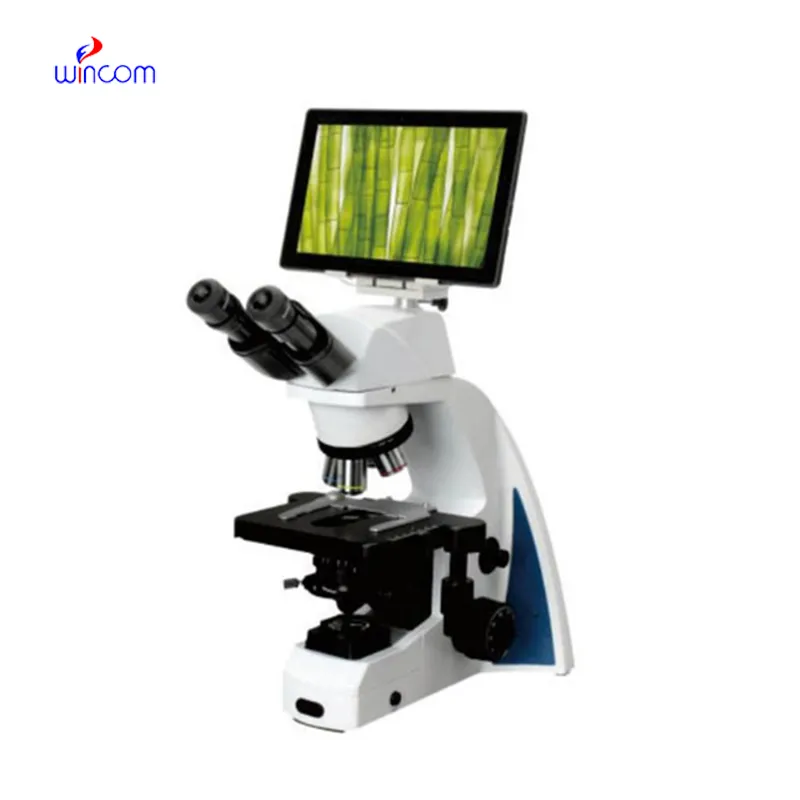
The portable microscope for environmental sample analysis is engineered for precision and versatility, featuring adjustable magnification levels and ergonomic design for continuous use. Its optical system delivers uniform brightness and sharp focus on different specimens. Equipped with illumination controls within, the portable microscope for environmental sample analysis maximizes contrast and clarity, enabling easier observation of delicate structures. Digital cameras and connectivity options for real-time image acquisition and sharing are included in most models. The portable microscope for environmental sample analysis is built with durable materials to maintain stability of performance despite routine laboratory use.

Versatile in use, the portable microscope for environmental sample analysis has extensive usage in laboratories, universities, and manufacturing. It is used to provide precise observation of living organisms, minerals, and artificial materials. In life science research, the portable microscope for environmental sample analysis helps examine cellular processes and structures of genes. Metallurgists make use of it to examine grain boundaries and fatigue cracks, while chemists make use of it to examine crystalline compounds. It is also used in the textile industry to assess fiber quality and compositional structure at high magnification.
With the progress of technology, the portable microscope for environmental sample analysis will turn into a smarter and more interactive research tool. Compatibility with AI will allow it to detect patterns, recognize anomalies, and measure data automatically. The portable microscope for environmental sample analysis will also make remote diagnostics possible, where the samples from every corner of the world can be diagnosed remotely by specialists. Advances in imaging sensors and optical systems will provide better depth resolution and faster capture rates. These will expand the uses of the portable microscope for environmental sample analysis in medicine, nanotechnology, and education.

Proper care and maintenance of the portable microscope for environmental sample analysis ensure long-term performance and image precision. Lenses should be cleaned periodically with lens paper or optical wipes to prevent dust buildup leading to distortion in clarity. Mechanism parts and the stage should be clear of debris and dry. After use, the portable microscope for environmental sample analysis should be dust-shielded and kept low humidity. Verify the lighting system every now and then and change bulbs or LEDs when brightness declines. Calibration and adjustment by professionals guarantee accuracy and mechanical solidity are maintained at constant levels.
The portable microscope for environmental sample analysis allows researchers to study the world at a microscopic level with stunning detail. Using high-tech optical or electron systems, the portable microscope for environmental sample analysis magnifies samples to reveal texture, layers, and details that are imperceptible to the human eye. From life sciences to factory quality control, uses span the range. Portable and compact models now combine ergonomic design and digital controls to offer comfort, accuracy, and dependability for extended observation periods.
Q: What are the main parts of a microscope? A: The key components include the eyepiece, objective lenses, stage, focusing knobs, and illumination system, all working together to magnify and clarify specimens. Q: How do you clean the lenses of a microscope? A: Lenses should be cleaned using soft lens paper or microfiber cloth with a small amount of lens cleaner to avoid scratching or damaging optical coatings. Q: What magnification levels can a microscope achieve? A: Depending on the model, a microscope can typically achieve magnifications ranging from 40x to over 1000x for detailed observation of microscopic structures. Q: Why is light adjustment important in a microscope? A: Proper light adjustment ensures accurate contrast and brightness, allowing clear observation without distortion or glare during viewing. Q: Can a microscope be used for educational purposes? A: Yes, microscopes are widely used in classrooms and laboratories to teach students about biology, materials science, and microscopic analysis.
The microscope delivers incredibly sharp images and precise focusing. It’s perfect for both professional lab work and educational use.
The delivery bed is well-designed and reliable. Our staff finds it simple to operate, and patients feel comfortable using it.
To protect the privacy of our buyers, only public service email domains like Gmail, Yahoo, and MSN will be displayed. Additionally, only a limited portion of the inquiry content will be shown.
Could you please provide more information about your microscope range? I’d like to know the magnif...
Could you share the specifications and price for your hospital bed models? We’re looking for adjus...
E-mail: [email protected]
Tel: +86-731-84176622
+86-731-84136655
Address: Rm.1507,Xinsancheng Plaza. No.58, Renmin Road(E),Changsha,Hunan,China


 EN
 af
 es
 ar
 tr
 sw
 pt
 th
 ur
 bn
 ne
 vi
 km
 lo
 de
 ru
 fi
 nl
 fa
 fr
 ko